

On the first day of her artist’s residency in Tbilisi, Georgia, Ruofan Chen found a fiberglass wall insulation sheet on the floor of a condemned building. Smooth and roughly human-sized, worn into it was a hollow. Something had been hibernating there, inside this abrasive material. Chen considers this a pivotal moment of clarity: exposure is distributed by position and only time reveals its cost.
Chen's work involves sawdust-strewn floors, edible powders, and paintings at the edge of visibility - each showing in real time what time can take decades to manifest.
Born in 1996 in Hubei, and trained at the Affiliated High School of the China Academy of Art, the School of Visual Arts in New York, and the Royal College of Art in London, Chen has exhibited internationally at Tai Kwun Contemporary in Hong Kong, the 15th Shanghai Biennale, Galerie Perrotin, and the Saatchi Gallery, alongside a recent solo exhibition, Dull Ache, at the LC Queisser in Tbilisi. We spoke over video. Our conversation has been edited for length and clarity.
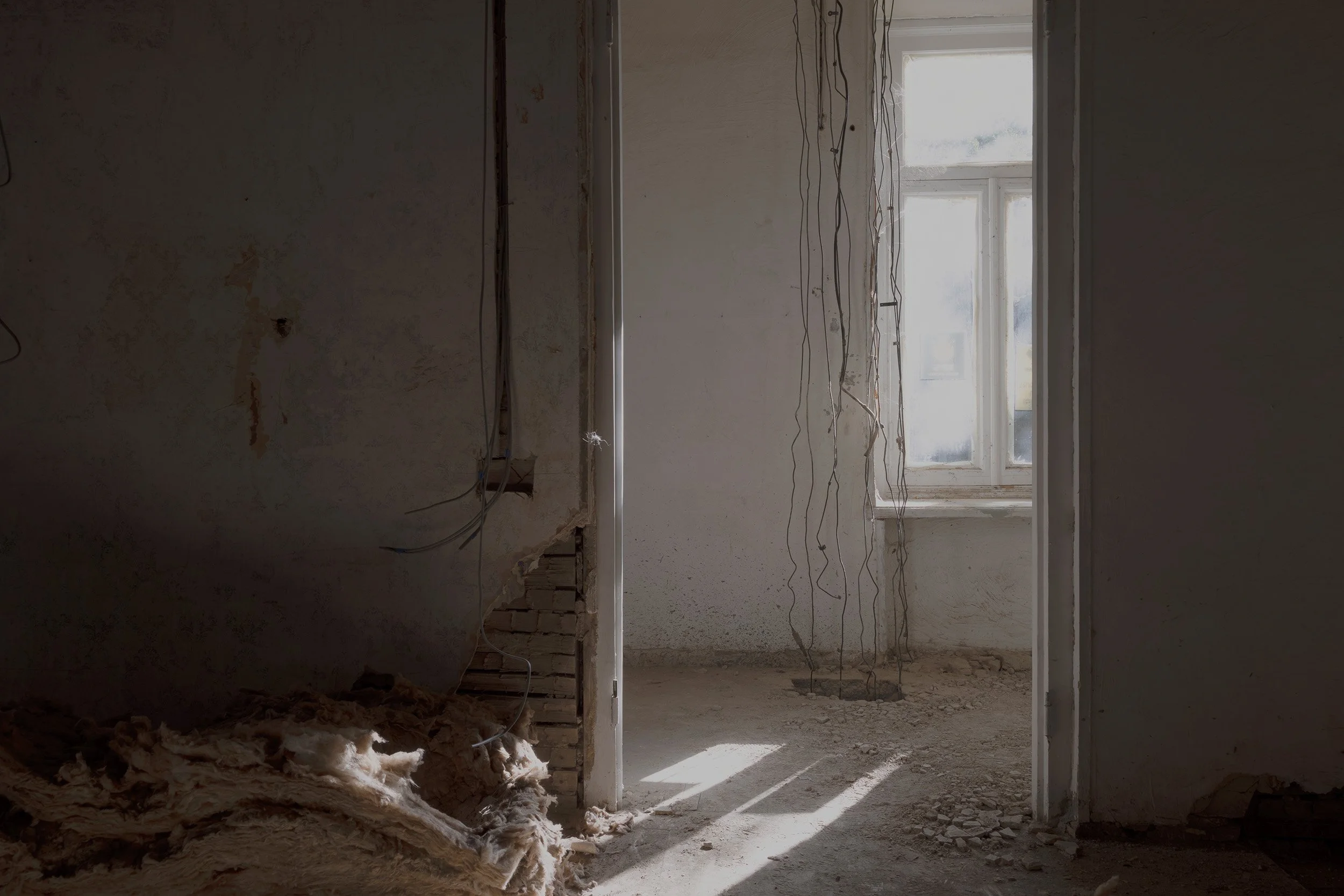
Start in Tbilisi, with the insulation, because you have called it the starting point of everything. What did you find?
The building was an abandoned space; they wanted to renew it really soon. That became the show during my residency. On my first day, I went to the space and I saw this material. A fiber wall. Its purpose is to isolate the warm and the cold… inside the wall. Because the place was almost abandoned, I think for half a year, they put it out. And I saw this small carved-out shape. It seemed like some animal had been sleeping there for a long time. You could tell, because the carving was so smooth. But then I immediately thought, if they were to stay here, maybe they won’t survive. Because during the winter, Tbilisi is really cold.
You were experiencing firsthand what material does to a body.
Yes, in Germany I was using that material [fiberglass], from a supply shop, and I did wood carving on top of it, and my fingers got really hurt with the fiberglass getting into my skin. It took two to three hours to get them out, using tape to tape them out. Still, for that month, every time I took a shower, I felt a bit hurt. Just a little bit, so it was fine. But it’s hard to imagine those animals sleeping there, almost every single day.
And in the work, instead of fibers, you used fishing line.
The real ones are really small, really tiny; you cannot see them. So I used fishing line to simulate the feeling. I simulate them using a safer material that is more visible. All of my research, at the moment, leans heavily into fiberglass.

That research eventually put you in a Temu furniture factory. How did you end up in there?
After I graduated, I didn’t have a wood shop to work with, and I was planning to do a wooden installation, a huge sculpture, so I had to find a space. In China, it’s hard. All the factories are quite huge, and they don’t want to accept an artist because we don’t really have that much of a budget, plus we often ask for really complicated work. The only factory around that accepted me was one that made furniture for Temu. So all the quality is really, really low. The glue is really bad, the machines are really messy, and really dangerous.
How polarizing is a factory floor compared to the rooms that you were formally trained in?
In school, it’s kind of the opposite. You have a mask, protection, you have everything. In this factory, it’s really messy, and there is no light. One window of sunlight; that is your only source of light. And it is really dangerous. I stayed there for one month. Some of the workers were cutting off their fingers, and no one paid attention.
They’re just used to it. Almost everyone has a bad lung problem, so they can’t wear masks. Because if they wear one, they can’t breathe.
You’ve just described the whole condition in one sentence. The air is so bad that the protection against it is unusable?
Yes. And they do the sprays for the furniture too, the varnish, and they don’t even have a separate spray room. I brought my laptop to the factory once, and within thirty minutes, it was completely covered in dust. My first time entering the factory, I thought it was amazing. But when I looked carefully, and really saw all of it, I could feel the harm.
During my time there, I got really sick, from my nose.

The sculpture that came out of that month has a very specific referent: the body, your organs.
Because when you get really sick, it feels almost like a fiber and stone texture sliding through your body. So the shape of the sculpture is representing your organs, the heart, lungs, stomach, structuring the gray stones and silicone on top.
It appears you often examine the human body under stress, in some ways.
Yeah, because I think all my work stems from my personal experiences, feeling something through the body then translating it into the visual.
 Ruofan Chen. Vessels, 2026. Fuel feedline, sawdust, woodchip.
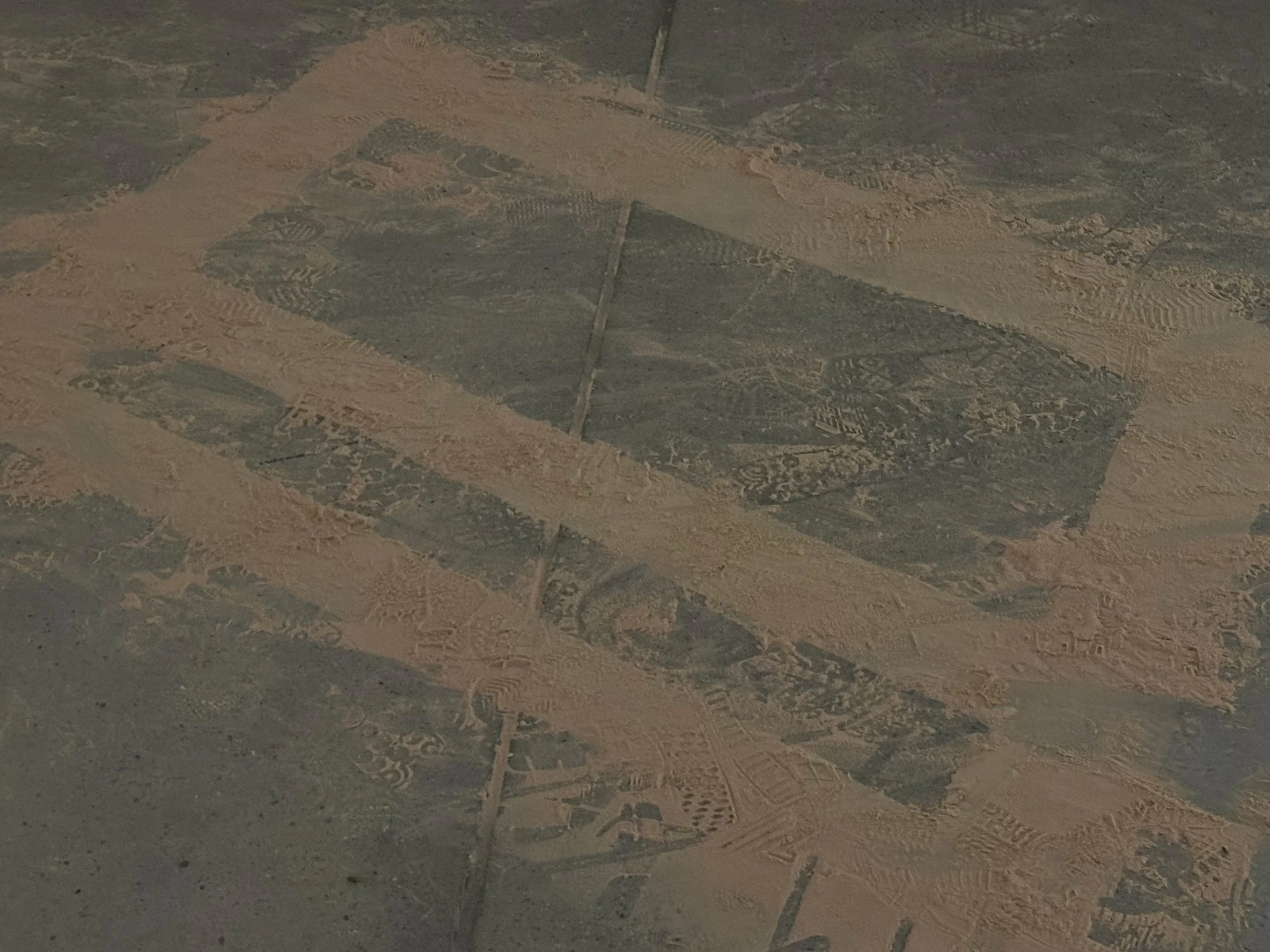 Ruofan Chen. Dust, 2025. (Close up).
 Ruofan Chen. Solace in the bench, 2024.
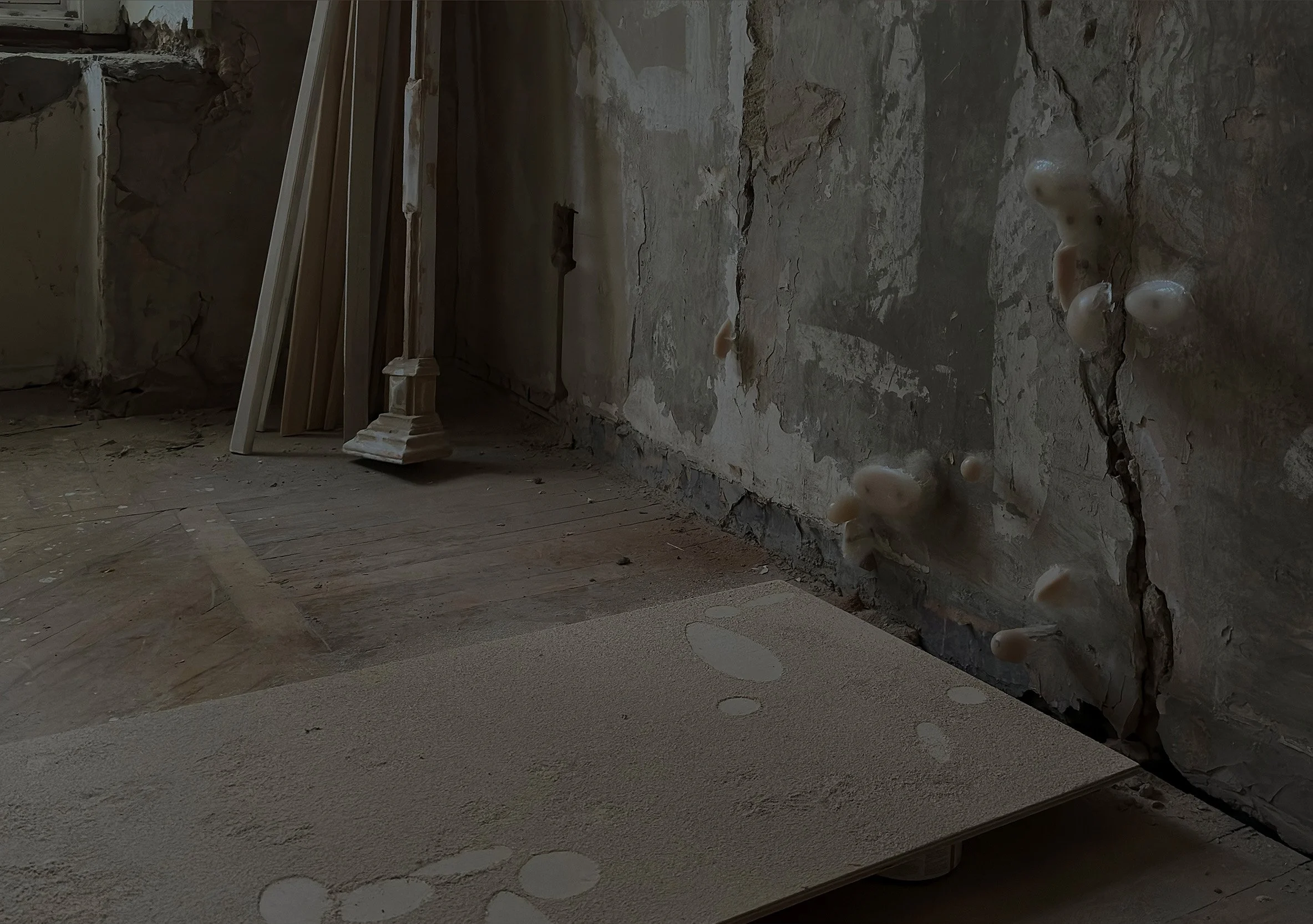 Ruofan Chen. Penetration, 2026. Silicone, Georgian wool, canned cat food, sawdust, wood, and bamboo. Dimensions variable.
 Ruofan Chen. Vessels, 2026. (Detail).

Which brings us to the sand, what this piece is named for.
This project is shoe-shaped, where I am separating space through the scultpure, pushing away the clean air and light and compressing darkness. When I was doing small research in Korea, you see that rich peope vs others are separated by rivers.
Like a class divider.
Yes. You see it in the art world too. So I found this sand from an indoor horse-riding place, owned by a private museum in China. When I went to the opening of that museum, I remember the director being really proud of their sand. He said: “Our sand is dust-free sand.”
Dust-free. They also had a performance of some kind with champagne horses. I became curious about the material, so I asked them for their supplier. They told me all the sand is shipped from France, and it’s quite luxury with a high maintenance fee. The grain is really, really fine, and really heavy. They even use a special fiber to hold it to the floor so that when the horses are riding across, the net contains it.
Describe what you built with the sand, layer by layer.
There are three layers. The top layer is like a net. In the middle is organza and silk, and it is really thin, but the sand can even go through the silk. The third layer is the sand mixed with paper. I made handmade paper with that sand.
And the argument is a distance argument?
It was really ironic. Factories barely enforce a system to protect from dust, but these people [horse riders] spend a lot of money just trying to protect themselves. When you are riding a horse, the distance is so big: it is maybe two meters from your nose to the floor. But the workers, they have to face it every day. So I switched it around: the protected one in the light, and the sand in the back.
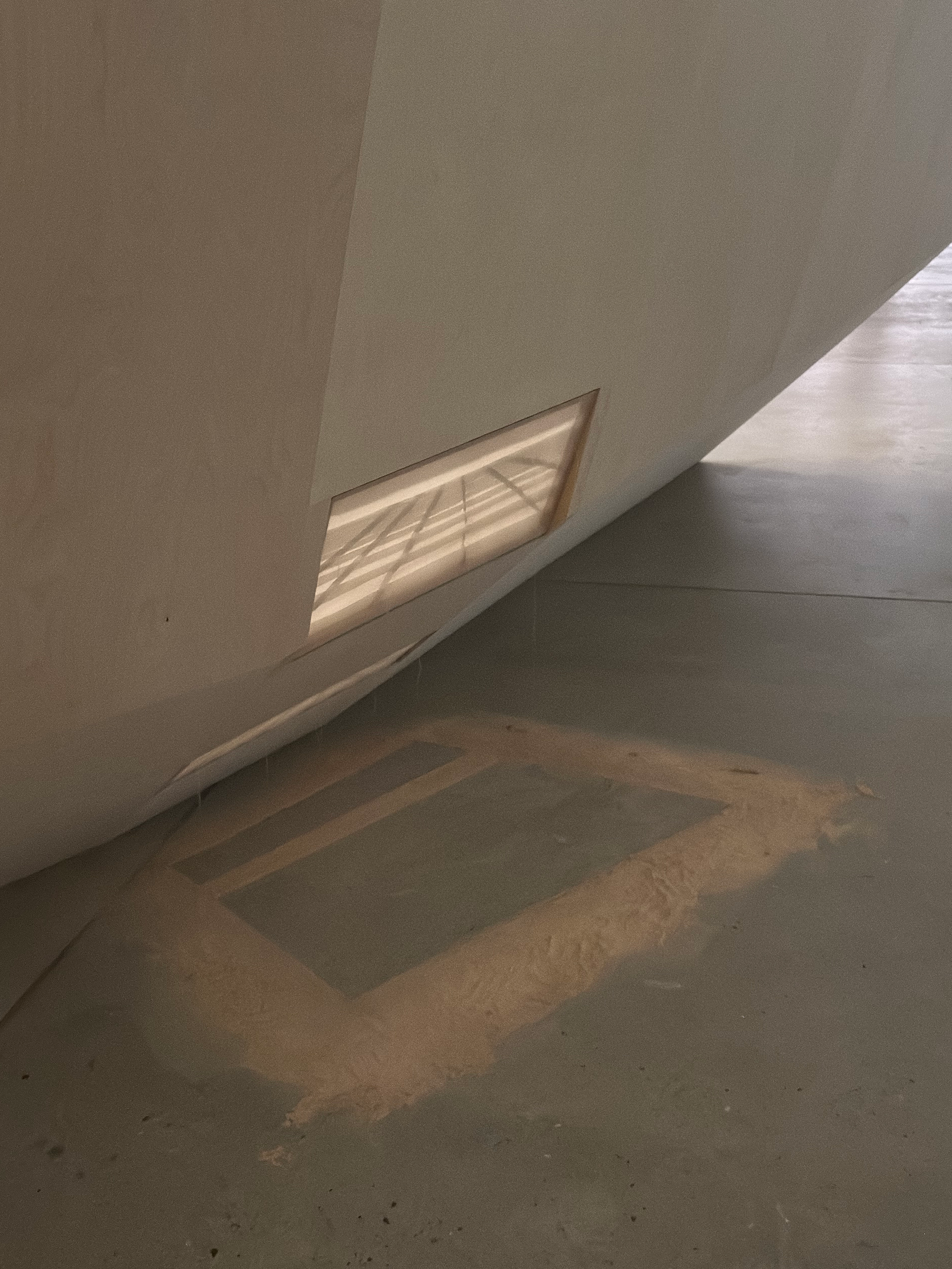
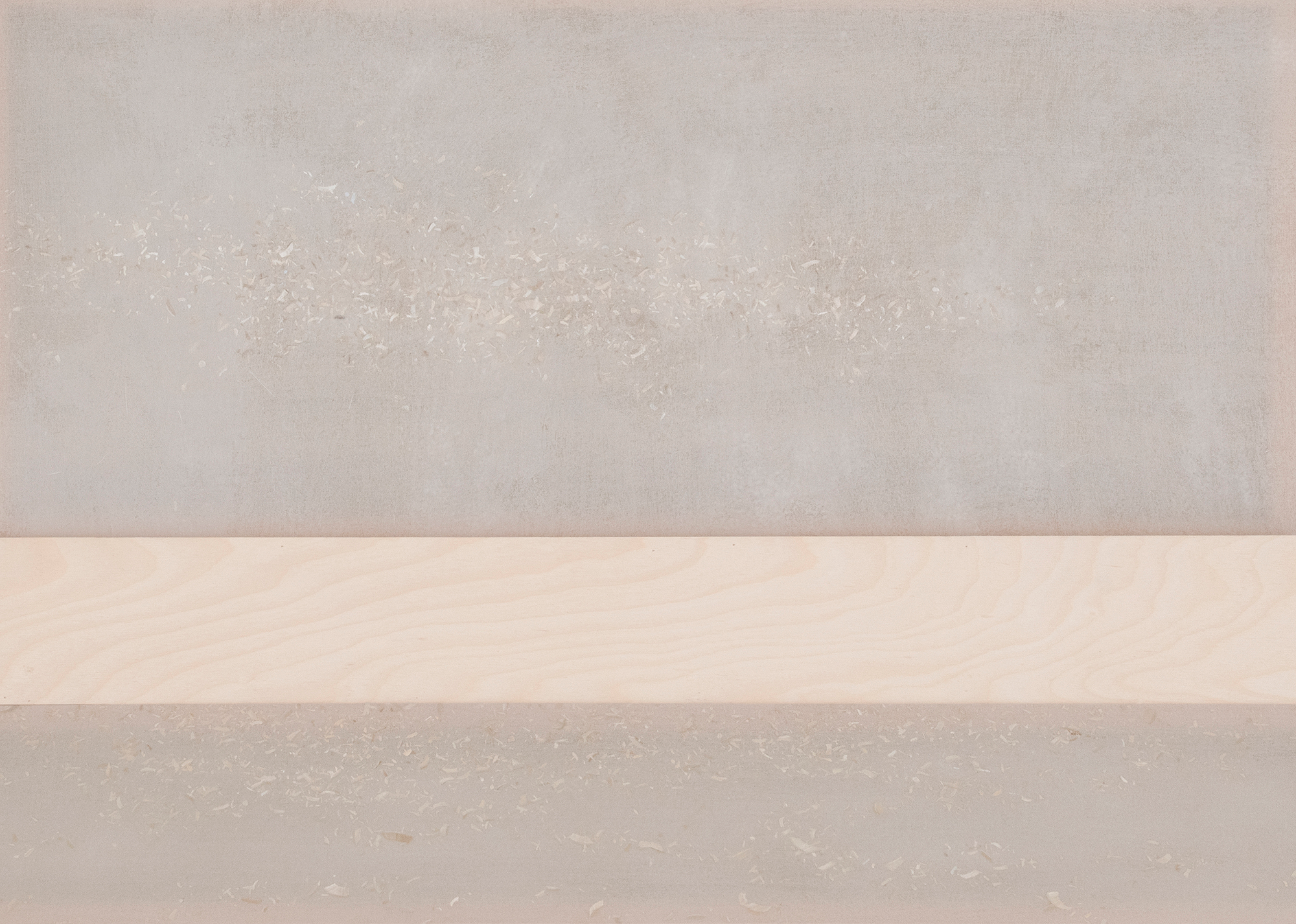
The painted layer is not photography, and I want to press on why. In the past you had used photography to create sand simulations or animations to replicate the layers. Here, you’ve decided to use the physicality of oil painting, layered with silk, patchwork, and dust.
During the pandemic period, I transformed my work into the digital, so I made simulations. It was really hard to face the workers, to use them, to photograph them. I feel really sad when I have to put my phone on to their daily lives.
By painting on top, from a distance, it appears like nothing. But because the fabric is translucent, plus the light, you can see the painted layers a bit more from the back.
Which alludes to the same dichotomy, your distance argument. It feels window-like, a natural air-flow, or maybe resistance, the essence of bleeding from one side to another.
When we were building the structure, we collected the dust from cutting wood, setting it in the space so the audience could step on it. At first, they're gonna ignore it, but the texture is different.
I also did a food version of my dust. I used yellow bean powder to simulate the dust. You could ship it onto your plate, and you could eat the dust. Because the wood does not have that much smell, but yellow bean powder has a strong smell. If you can smell it, that means the particle is already in your nose. Same as the wood dust: while you are in the space, all the small wood particles are already absorbed by your body and stays for the whole day.
It sticks to you.
Yes. And I wanted to translate that in a casual way, to feel it.
Food shows up on the other side of the ledger too, in the Wuhan chairs. A different take where the piece is about what sustains the labor rather than what the labor inhales.
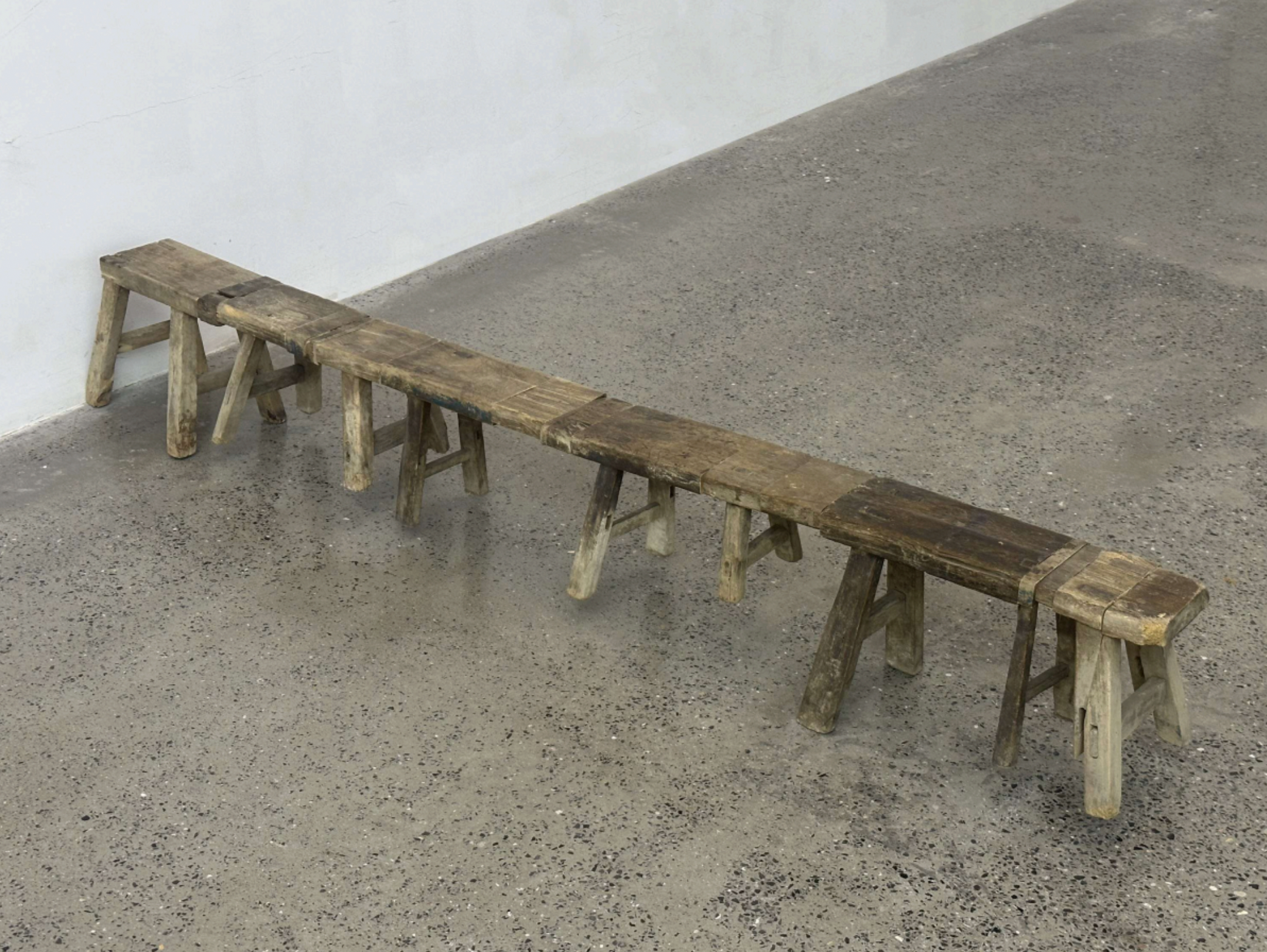
Wuhan is a really heavy industrial city. I am a foodie, and when I go to some cities, the first thing is I try the local food. So I went to noodle shops and breakfast places, because they are quite famous for breakfast, I collected those chairs from the owners and put them together.
The chairs still hold body heat. That detail is the piece. There is an earlier work I want on the record because it prefigures the simulations: the sunlight piece from 2023.
When I stepped into the space, I saw this sunlight (only for) about half an hour. And I wanted to remake this sunlight. So I simulated it. I made the model of the glass and the sunlight, and the trees, I 3D-scanned the trees, and made a fake one. The real one and the fake one are together.
Your work engages so many different sensations, as if you are building towards creating an environment, curating a space. It turns our attention to the exhibition itself, implicating each room the work is ever shown in.
Exactly. For every exhibition, I have to go to the space first and be in it as though I am borrowing. I want to have a connection with the space and maybe do some changes. Based on the environment, I make small adjustments.
Is there a community for you and this kind of work in China?
It is hard to find in-between artists in China. I think twenty years ago they still had some, but right now I feel really separate.
There is a version of your practice that would slide comfortably into the ecological-art category. It would tour, it would get funded, and it would flatten into message. What keeps it out of there?
My view is mostly about empathy, but it’s limited, because I know I cannot change everything. The system is so complicated and I do not exactly know how we should protect the environment, or whether what I do is useful. I am more intimate, finding the world and what to engage with through my work.

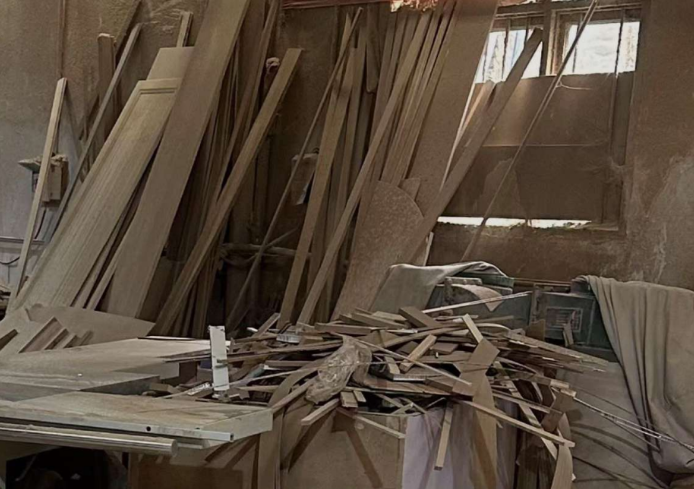
Image inside of factory. Photographed in Wuhan, 2024.
The materials change - fiberglass, sand, bean powder, sawdust - but the method does not: take something that usually stays hidden, at a distance, over years, and put it under a visitor's shoe in the space of an afternoon. Chen does not ask the viewer to imagine harm happening somewhere else. She puts the dust in the room, on the floor, on the plate. You are standing in it before you have decided what it means.
CREDITS
Artwork by Ruofan Chen
Header by Ruofan Chen
Heavy Dust, 2025. Installation view.
Written by Claro Concetto
Interviewed by Jet Le Parti