

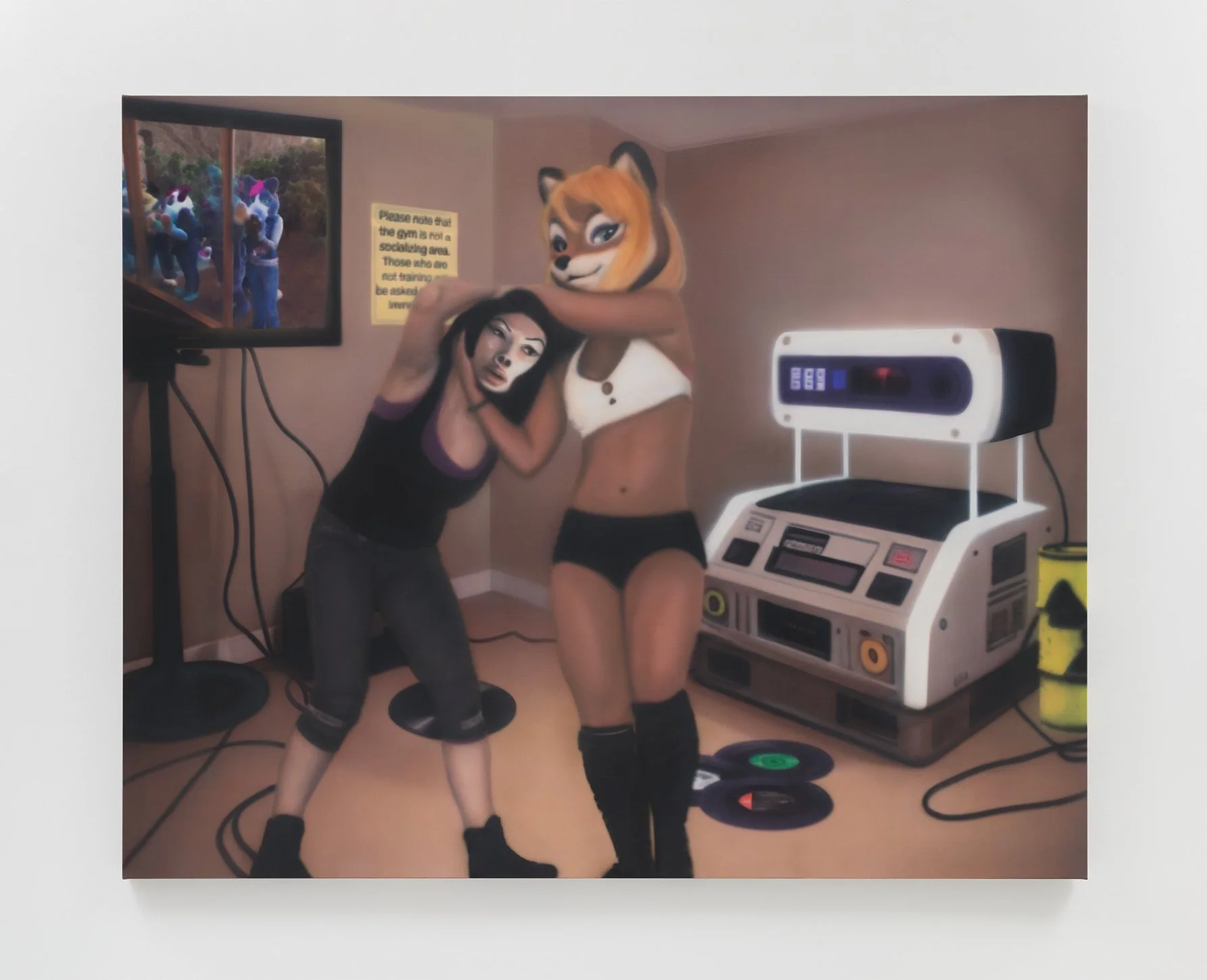
“Jihyoung Han’s worlds are already ending, but they refuse the solemnity apocalypse is supposed to demand.”
Jihyoung Han, Peace is unpredictable, 2025. Acrylic on canvas, 150×185 cm
Skeletons play instruments, pumpkin-headed figures carry rifles, robots move through wreckage and cartoon bodies appear among burning houses and piled debris. Rendered with a soft, almost airbrushed finish, the scenes borrow the visual language of games, animation and digital culture only to fill it with estrangement, violence and absurdity. Catastrophe transforms from a single event into an atmosphere the characters move through, and the same instability runs through Han’s treatment of identity.
Raised between Tokyo and Seoul and later moving through Kyoto, Prague, Berlin and Amsterdam, she describes developing different personas depending on where she was and spending much of her life online behind aliases, avatars and manufactured selves. Those experiences reappear in fragmented figures: social outsiders, synthetic bodies and post-human characters moving through worlds where both home and identity have become unstable. In Han’s work, fragmentation is not simply evidence of collapse, but also the condition from which another way of existing might be imagined.
Could you speak to your development into the arts, your childhood in Seoul, and your first introduction into painting, photography, or whichever medium you first started to explore?
I originally trained in music, spending my early childhood moving between Tokyo and Seoul. My mother was a researcher of Japanese culture, which meant my upbringing was saturated with Japanese visual media, magazines, and manga. During elementary school, I became obsessed with collecting Gundam plastic models and Ball-Jointed Dolls. That was my initial entry point into physical craftsmanship like assembling, painting, and customizing these figures by hand. Since I was too young to own or operate an airbrush, I improvised endlessly, layering enamel, colored pencils, and soft pastels to mimic a delicate airbrushed finish.
By my teenage years, my focus shifted decisively from music to visual art. I began sharing my work online, operating a blog soaked in full teenage existential angst, dark, heavy, and performing a sort of solemnity I hadn't yet earned. I desperately wanted to project the quiet world weariness of an adult artist. Ironically, the performance worked: older art students took the bait, mistaking my melodramatic online persona for genuine maturity. I found myself adopted by university art majors who treated me like a contemporary. Looking back, tricking college kids into becoming my cultural mentors was a stroke of luck—it fast-tracked my exposure to cinema, music, and theory that were vastly beyond my years, permanently skewing my artistic sensibilities.
Beyond relocating between institutions, there was a phase in my life where I was essentially moving to a different country almost every month. I lived in Seoul, Kyoto, Prague, Berlin, and Amsterdam, constantly searching for a space where I felt entirely at home. Navigating these cultural shifts firsthand forced me into a fluid relationship with my own identity. I found it fascinating how my sense of self transformed depending on geography, I developed distinct personas for each environment. My mode of being in Berlin or Amsterdam was fundamentally different from who I was in Kyoto or Seoul. My current practice directly interrogates these fractures. It revolves around fragmented selves and fractured characters born from relentless cultural transition. The fluid identities I navigated while constantly on the move have seamlessly bled into my visual language and overall creative process.
Having moved between various educational & cultural contexts internationally from K Arts to Prague, Kyoto, then back to Korea for your masters, how have the transitions shaped your personal experience and artistic process?
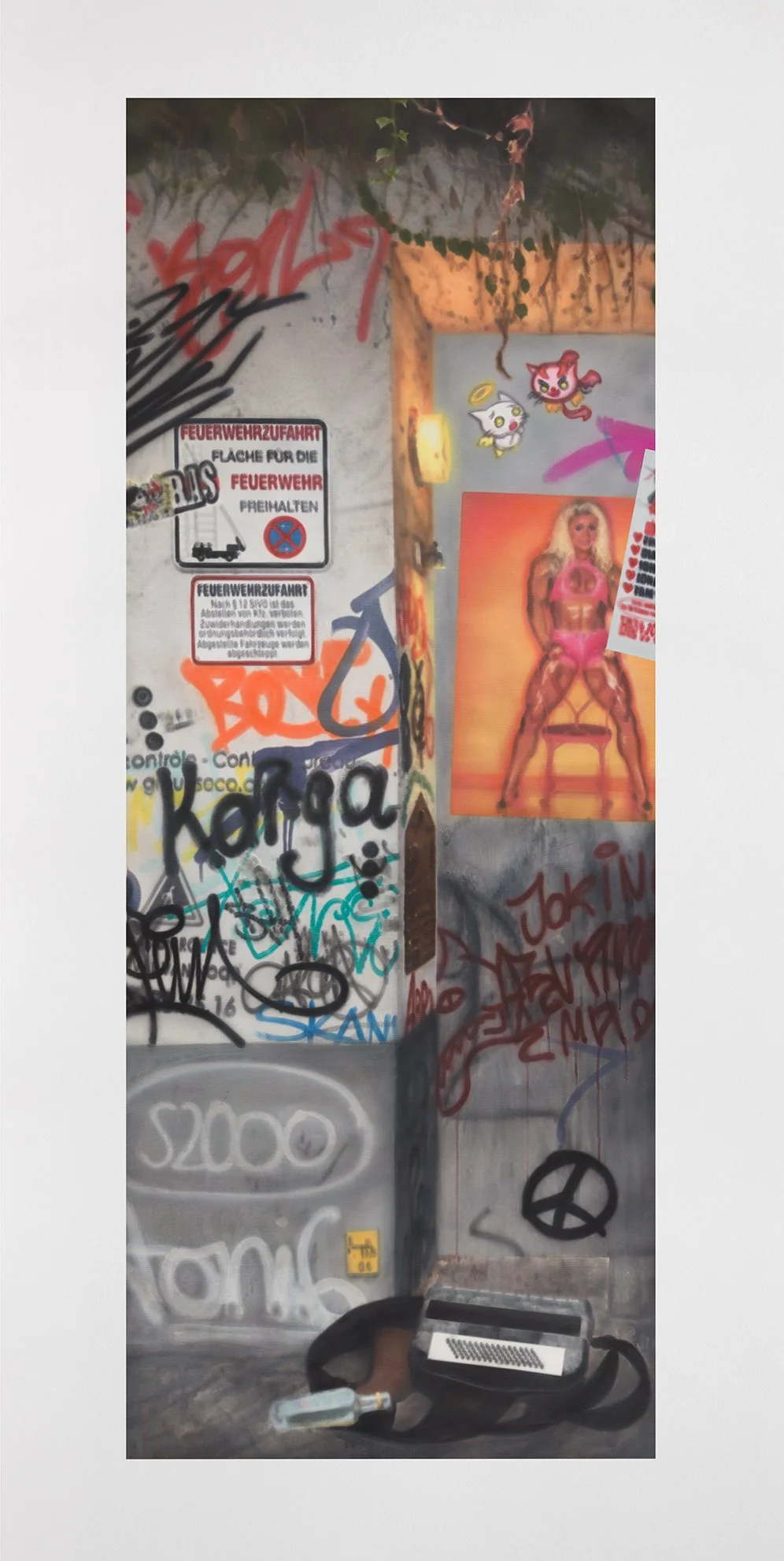
Jihyoung Han, Nostalgia House, 2026. Acrylic on canvas, 82×220cm
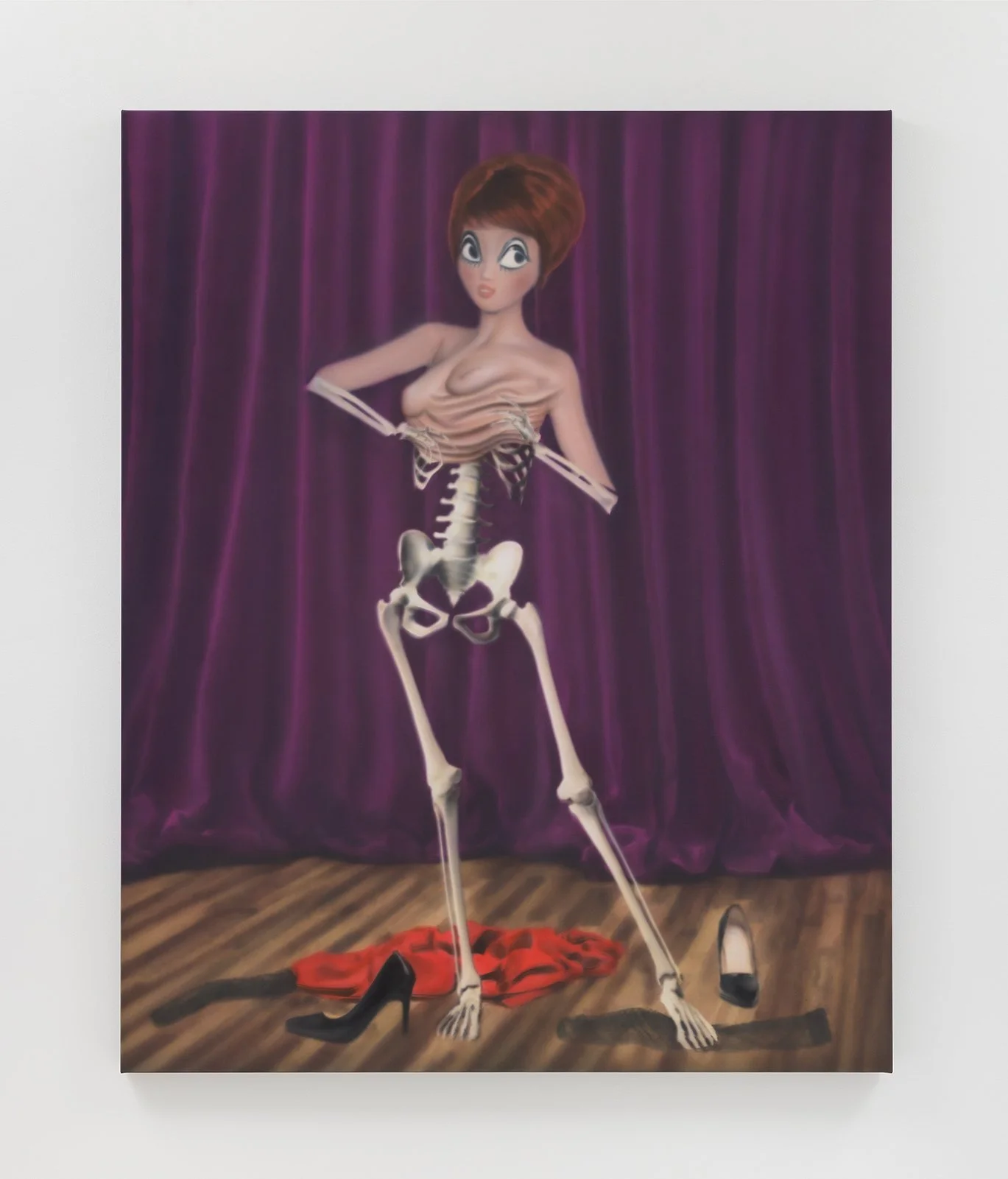
Jihyoung Han, Marvelous is your name, 2025. Acrylic on canvas, 162.2×130.3cm
What were some early influences—whether artists, films, games, literature, or other forms of culture—that left a lasting impression on how you think about narrative, space, and the body?
My cultural genealogy is strictly categorized by distinct eras, each leaving a clear imprint on my spatial and existential consciousness. In my early childhood, around age eight-nine, I was completely consumed by Nexus: The Kingdom of the Winds, an early MMORPG. Even then, I was already staging my identity, masquerading as an adult to navigate online networks. More than a game, it was an early lesson in digital deterritorialization. Traversing an infinite virtual geography cultivated a sense of worldlessness, a freedom from physical locality that ultimately primed me for a life of continuous nomadic transit, refusing to stay rooted in any single space.
By my teenage years, my focus transitioned from gaming to the surreal psychological architectures of Satoshi Kon, alongside seminal anime like Akira and Neon Genesis Evangelion, complemented by a relentless consumption of manga. During high school, this shifted toward a melancholic sonic palette like Air, Tahiti 80, and Röyksopp, intertwined with the transgressive aesthetics of Shūji Terayama and Suehiro Maruo, which reshaped my understanding of body horror, theatricality, and eroticism. As an adult, I turned almost obsessively toward critical theory and philosophy.
The common thread unifying these disparate influences is a preoccupation with post-apocalyptic survival, the existential absurdity of the human condition, and a quiet revolt against bodily and spatial limitations. Together, they formed the ontological framework of my current practice, questioning how fractured bodies and alienated selves navigate world-ending landscapes and synthetic environments.
Across your exhibitions, your work has moved through a wide range of mediums and surfaces. Are there any shows you think back to as feeling especially honest to who you were and what you were thinking through at the time? Or, conversely, any that feel like a version of yourself you would not return to?
I am someone defined by constant flux, and my art naturally mirrors that restless evolution. A body of work cannot remain static when the person creating it is perpetually shifting. Looking back, the solo exhibition Them so good stands out as the most raw and honest articulation of where I was at the time. At that point, I became profoundly overwhelmed by a quiet existential weight: the realization that as human beings, we are irrevocably trapped inside our given physical bodies. I found it profoundly alienating that I could never transform into another form, another object, or another entity. Is it truly possible to simply accept the physical vessel one is born into? I attempted to project myself outward, striving to escape my own boundaries and become something else entirely, yet I remained inescapably bound to myself. It forced me to ponder what it might mean to reconcile with this corporeal container, or whether an equivalent exchange of identity between self and other could ever be possible. Them so good directly confronted these ontological anxieties, addressing themes that continue to serve as the structural spine for my entire artistic practice.
Your work feels like a dystopic reworking of contemporary imagery—digitally alluring, airbrushed, almost animated. There’s a somber atmosphere in the work, but also a dose of irony. What draws you to that tension?
While I navigate daily life with a sense of vitality, the world unfolded before me rarely feels bright. I am constantly struck by moments of gloom, grief, and bleakness, punctuated by arbitrary mockery, anxious premonitions, or a passing sense of tragic absurdity. We live inside these scenes, sharing both the space and the quiet agony within them. It often feels like summoning the courage to step onto a dance floor and move, only to realize there is no audience and no spotlight. I create from within that exact tension, surrounded by heavy smog, peering into the obscurity ahead. Every day brings a turbulent emotional current. Because of this, I am driven to constantly seek new ways of existing, using my practice to imagine alternative futures that offer something beyond our present condition.
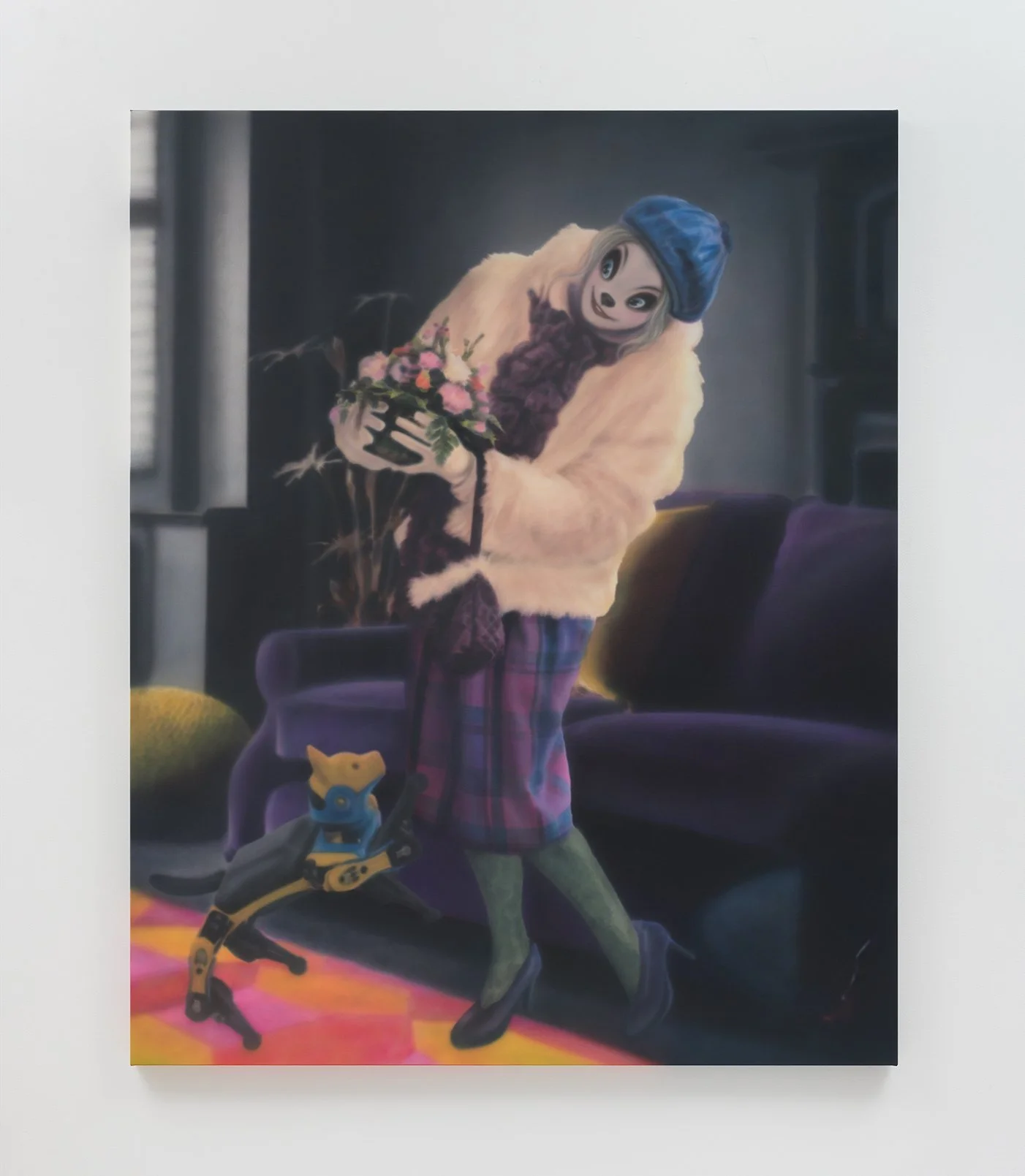
Jihyoung Han, Stand Amazed, 2024. Acrylic on canvas, 162×130cm
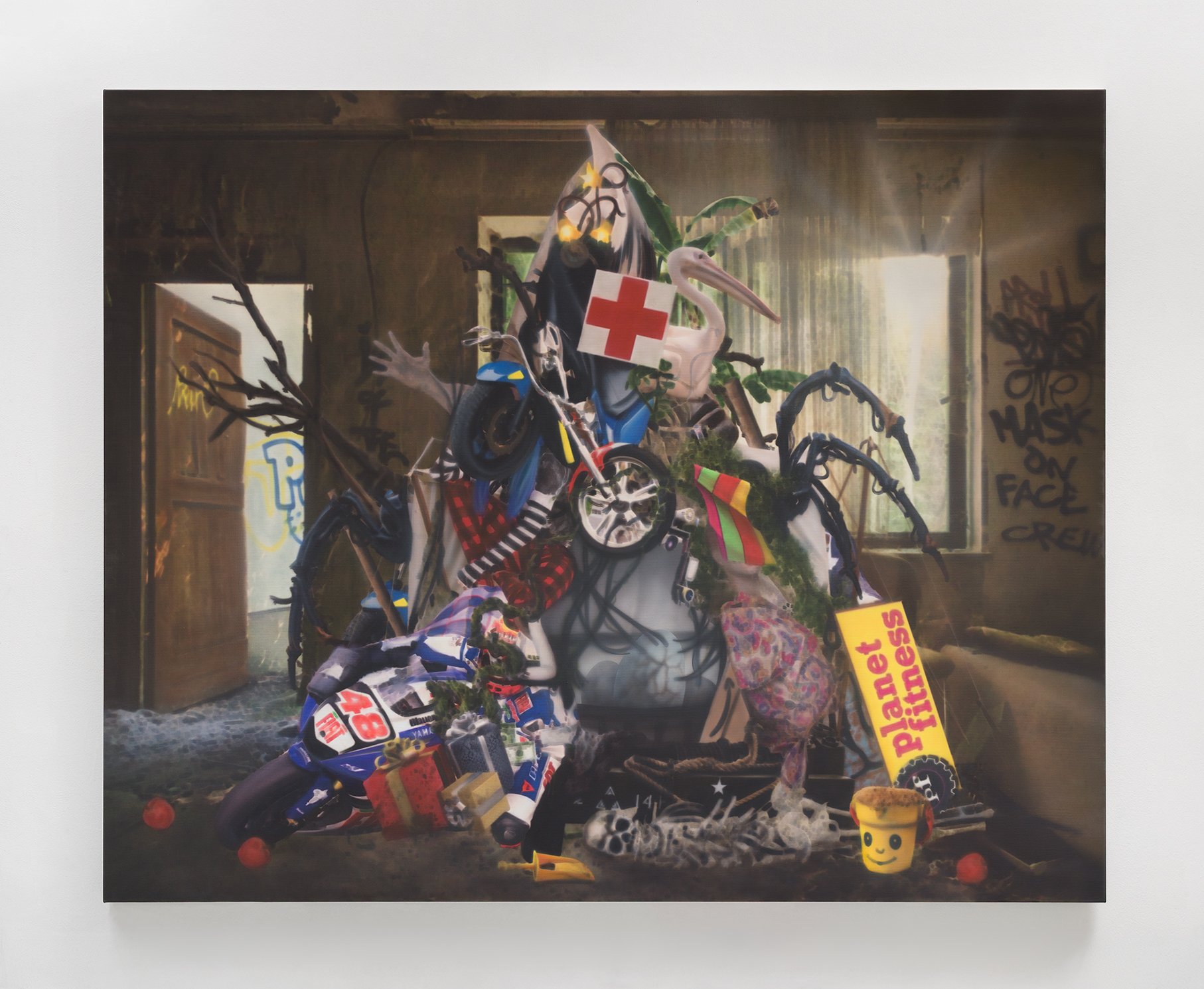
Jihyoung Han, And They Still Say Egg Is Expensive, 2025. Acrylic on canvas, 150×185cm
You have described your work as examining identities that are explored and reproduced within virtual spaces. How do you think the relationship between physical and digital identity has changed over the last decade?
We live in an age overwhelmed by synthetic and fabricated identities. The sheer proliferation of individual digital presence, online personas, and intellectual property has fragmented how we occupy space. With the acceleration of generative AI, we have arrived at a moment where altering one’s face, body, and digital materiality to exist entirely within a virtual realm is no longer speculative fiction, but a daily reality. Precisely because the boundaries between the physical and virtual have become so permeable, the urgency to anchor oneself has never been greater. In order to avoid dissolving into the relentless stream of generated content, we must hold firmly to our core existence. We are navigating an era that urgently demands a return to fundamental ontological questioning: What does it mean to be a real human being? And amidst this endless reproduction of the self, who are we, truly?
These figures / characters in your work, are they expressive of a certain kind of people? Or is it representative of all of our fates?
They are everyone around us, and they are equally the people in my immediate orbit. I view them as social outsiders, feral youth existing on the periphery of mainstream society. Yet, none of us inhabit a singular, fixed identity. Carrying these multiple selves grants us the capacity to occupy more than one perspective at a time, transforming our marginality into a way of seeing the world through multiple lenses at once.
Can you speak to your own personal experiences with contemporary digital life? Are there parts of your digital persona represented online that feel like the same fragmented identity you speak of in your work?
In the past, I operated under fake names like Midori Han Sour Kia. Having navigated online environments through manufactured online selves since childhood, adopting a pseudonym or hiding behind a character felt less like a disguise and more like a primary mode of being. I became far more comfortable functioning behind a mask than presenting a singular, unmediated version of myself in the physical world. That history directly mirrors the fragmented identity I explore in my practice. The avatars, alter egos, and digital surrogates I construct online are not distinct from who I am; they are real iterations of a decentralized self. Navigating contemporary digital culture means acknowledging that the mask is not a deception, but a necessary interface for surviving in an increasingly mediated world.
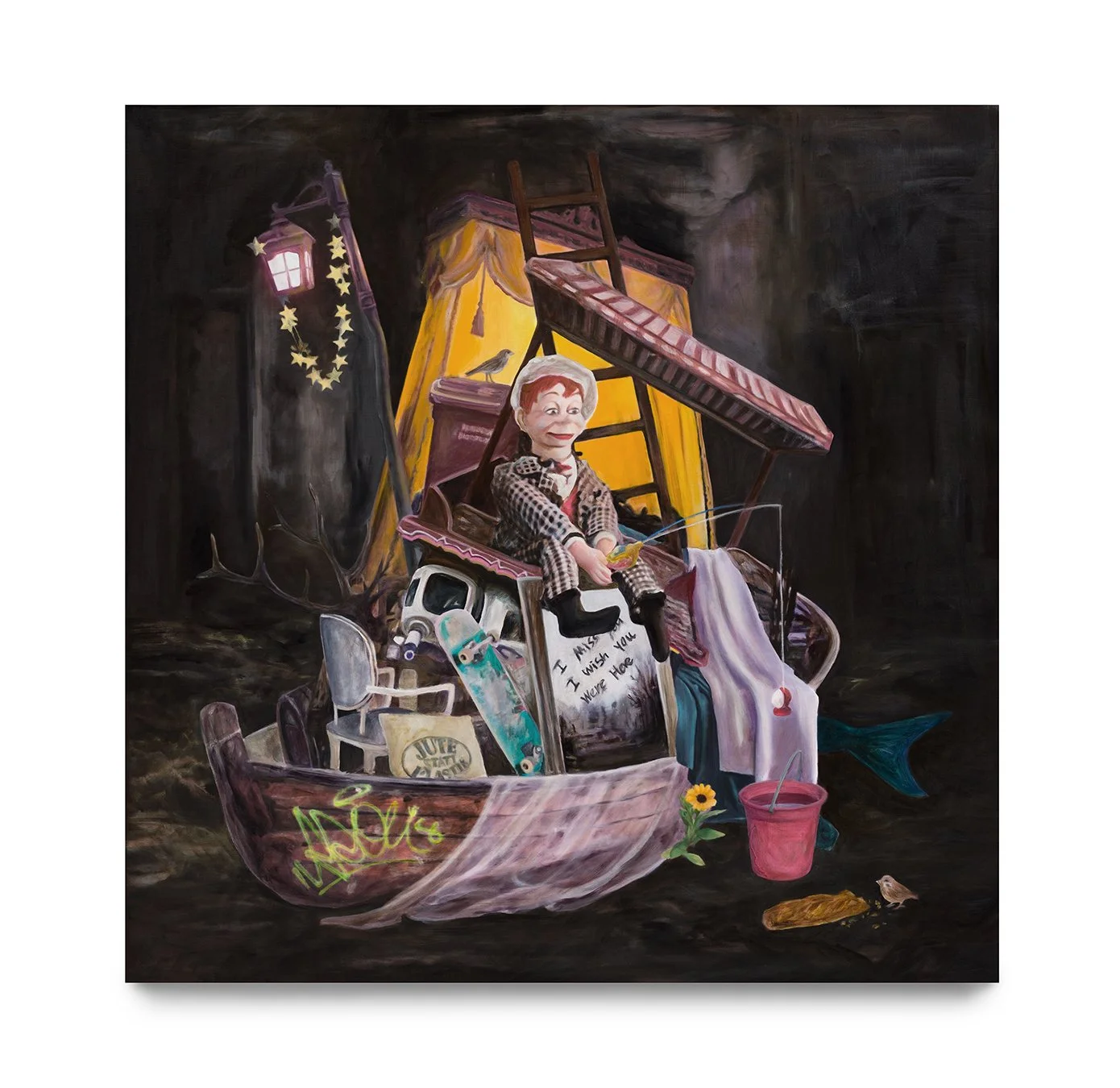
Jihyoung Han, There will come soft rains, 2026. Oil on canvas, 110×110cm
What aspects of contemporary culture do you find most interesting right now? Or contemporary discussions around technology, alienation, or identity?
I have been deeply intrigued by the ways contemporary media constructs, consumes, and sanitizes the archetype of the hysterical or insane woman. Throughout culture, the figure of the madwoman has served as a container for societal anxiety, a site where systemic deviance is pathologized and recast as personal spectacle. Today, mediated spaces refashion these breakdowns through hyper aestheticized visual tropes, viral spectacle, and algorithmic sensationalism. What fascinates me is how these depictions sit at the intersection of body politics, surveillance, and alienation: the madwoman becomes both a vessel for genuine revolt against oppressive structures and a commodified artifact designed for passive digital consumption. In my current thinking, analyzing this trope offers a potent entry point into how identity, trauma, and resistance are mediated under contemporary hyper capitalism.
What are you listening to lately, watching, reading, or keeping up with?
I recently rewatched Ralph Bakshi’s Coonskin. I have always carried a deep longing to create moving-image work, but because it demands a longer temporal commitment and sustained narrative pacing, I keep postponing it. Music-wise, I recently came across the artist Mohamed Bourouissa, whose album left a striking impression on me. As for reading, I am currently revisiting the works of Clarice Lispector, going through her texts one by one. There is an irreplaceable intensity in her writing, a hyper-awareness of existence, language, and the internal void that speaks directly to what I try to capture visually.
Can you share with us more about what is coming up for you next? Are there any exhibitions, projects, or bodies of work you are currently developing or finishing?
At the end of August, I am participating in group exhibitions at Ilmin Museum of Art in Seoul and Galería Mascota in Mexico. Preparing for these two shows has kept me entirely consumed throughout the summer. The piece I am presenting, Following in their ancestors' footsteps (Last lullaby), is a post human panorama painting that traces the process of world alienation, the vast crisis humanity faces amidst the blind acceleration of technology and capitalist isolation, while experimenting with Anthropocene landscapes and forms. The work unveils a visual narrative through an exploration of artificial environments, exposing the collapse of the public sphere, the loss of home hidden beneath modern civilization's promises of abundance, and the resulting arrival of an extreme worldlessness.
Jihyoung Han’s work is now on view at the Ilmin Museum of Art (August 26, 2026–October 25, 2026).
Header Jihyoug Han, Following in their ancestors footsteps (last lullaby), 2026, 220cm x 750cm, Acrylic on canvas
Artwork by: Jihyoung Han
Written by: Claro Concetto
Image courtesy of Jihyoung Han
CREDITS