
“The viewer is asked to consider the shifting currents of art and the United States: not only what is being made, but what it means to name something American at all.”
On the eve of America’s 250th engagement, I made my belated way to the Chelsea–Meatpacking district, home of the 82nd Whitney Biennial and its thirty-dollar ticket. I’ll leave the price there, except to say that thirty dollars sharpens the question of what, exactly, one is being asked to enter: the house of “Great American Art,” an institutional stage whose American posturing is impossible to separate from its power — especially now, as the Whitney approaches its centennial consecration. Congratulations on surviving long enough to become your own alibi.
The viewer is asked to consider the shifting currents of art and the United States: not only what is being made, but what it means to name something American at all. That second question is the Biennial’s real labor and responsibility. Curated by Marcela Guerrero and Drew Sawyer, the show declines to name a theme, preferring to let their studio visits of more than 300 artists “guide” it. The result reads less as open-endedness than as abdication. Without a thesis to stand on, the exhibition leaves its architecture to do the arguing — and it is there, in the sequence and spatial hierarchy most clearly orchestrated by the curators, that this year’s edition largely fails.
With the recent protests in New Jersey in mind — the heavy police presence, the streets toxified by tear gas — I entered through the institution’s sanctified gates with the not-so-distant memory of Warren Kanders’ resignation, only to be greeted first by an interspecies relationship between a dog and their owner.
I trust Louise Gossiaux’s drawings of London and ceramic Kong Play have already received their fair share of tenderness elsewhere. This is not a complaint about the dog paintings, which are perfectly fine, nor a denial of the delicate and deeply entangled sensory-informed relationship between an owner and their dog. Let’s just consider the framing. This is an observation about priority. To open here — in a year of open-air detention, renewed US–Israel escalation with Iran, a second Trump administration, and the consolidation of a techno-feudal class — is to make a choice about what registers and what does not in the room where the canon is set.
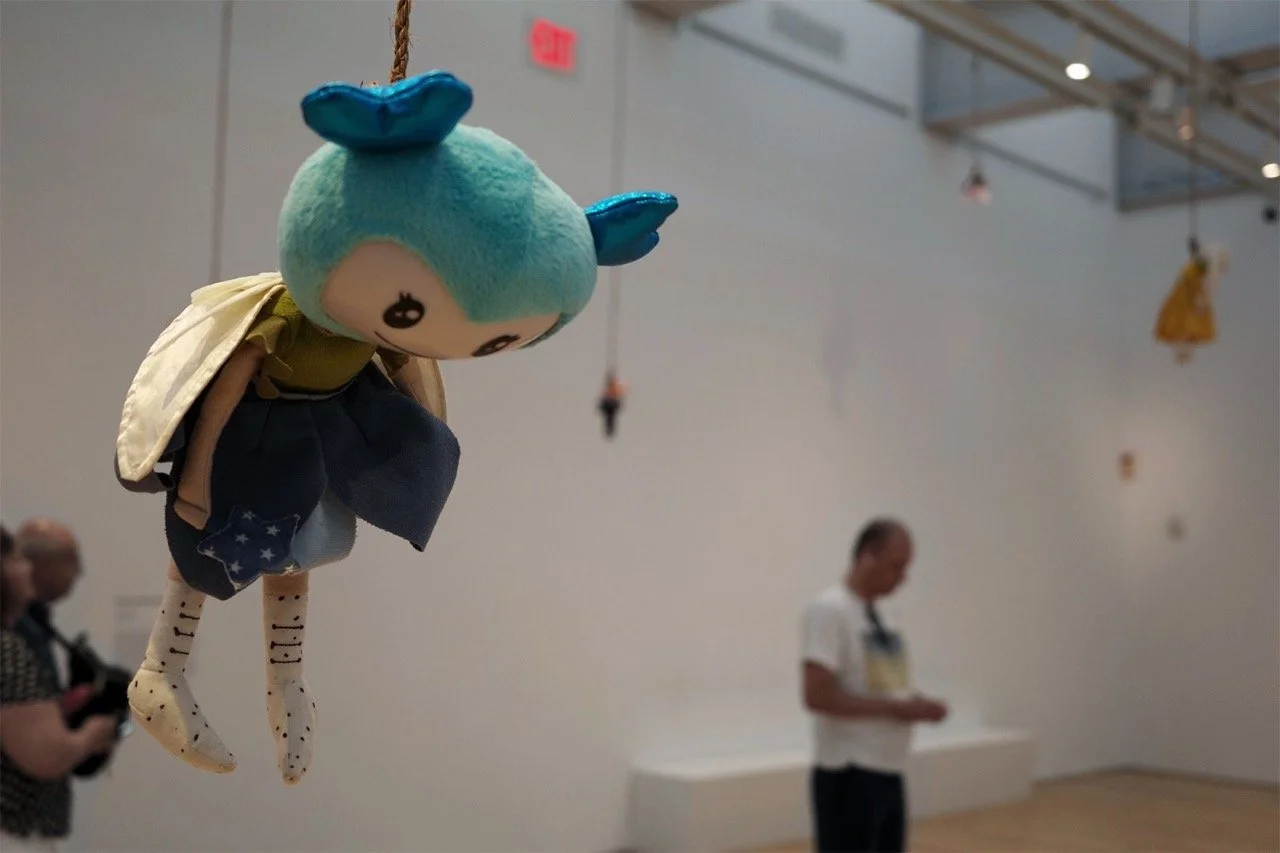
Eight floors above, is Precious Okoyomon’s Everything wants to kill you and you should be afraid (2026): fifty-five small creatures, sewn from taxidermied wings and salvaged toys, suspended from the rafters by nooses. Nearby, six figures fit the heads of mid-century blackface dolls into plush bunny suits. The reference to lynching is plain, and the work earns its plainness — childhood softness made the host for historical violence. It is among the strongest things in the building with any real somatic charge.
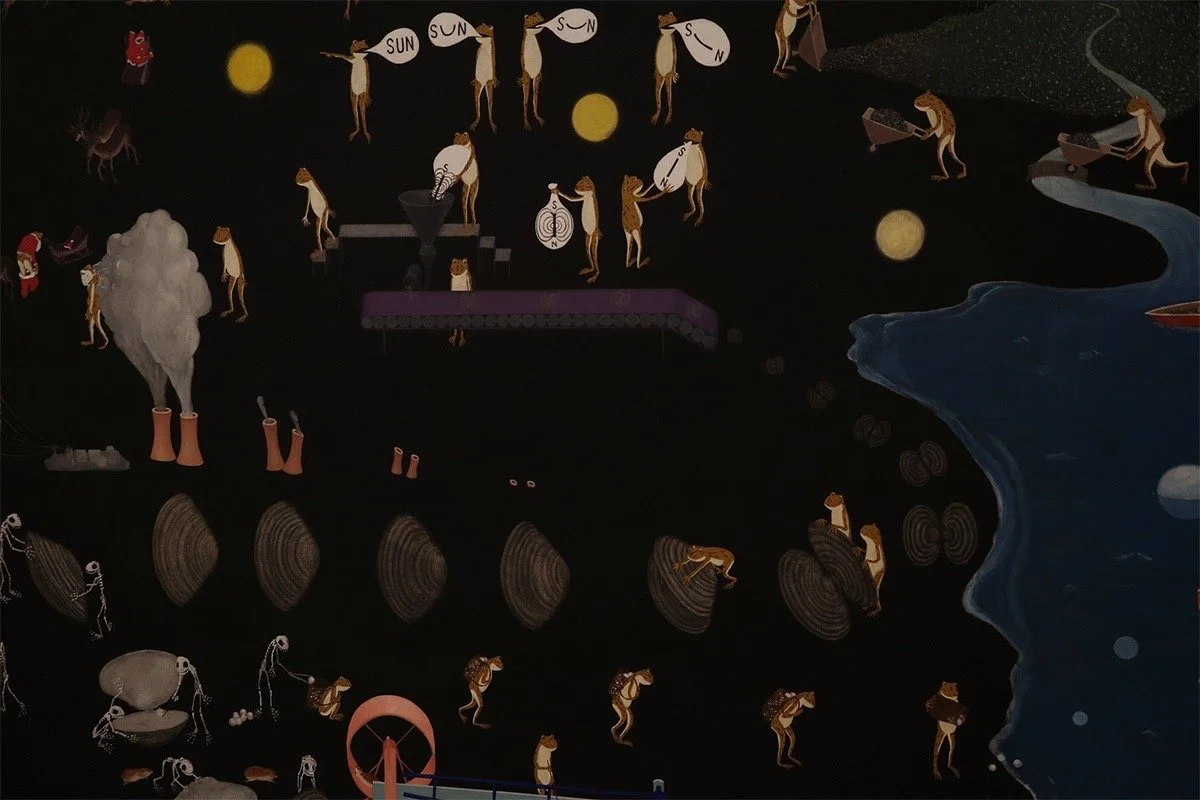
Within the same cluster of works, Akira Ikezoe shifts the register into ecological delirium: frog- and mole-creatures routed through a diagrammatic industrial system, life and death cycled through a power plant’s logic, equal parts medieval cosmogram and assembly line. The Sisyphean conveyor belt of production and addictive consumerism, depicted through Ikezoe’s fantastical lens, is granted momentary institutional visibility — and with it, our sanctioned attention. It’s funny to watch frogs, bodies, machines, dolls, and industrial hallucinations wedged between floors of Warholian collection rooms and other canonical holdings, where their manic systems feel more alive than the narratives around them. Ikezoe makes the surrounding canon look tired — and the show doesn’t seem to know what to do with that contrast.
“-the gestures of digital politics rendered in nylon. I welcome its eccentricity. It may be the show's truest self-portrait: a carnival jester performing an inflated promise.”
Emilio Martínez Poppe’s photo-text portraits of Philadelphia civil servants slot almost too neatly into the Biennial’s rubric of social engagement: drivers, sanitation workers, and municipal employees appear behind window screens, windshields, and office glass, routed along the circuits of public labor. The visuals are clear-eyed, the thematic point exact, and the work’s precision would hold up anywhere, which is exactly the problem. The strongest works here succeed in spite of the arrangement, not because of it — dulled by curatorial posturing.
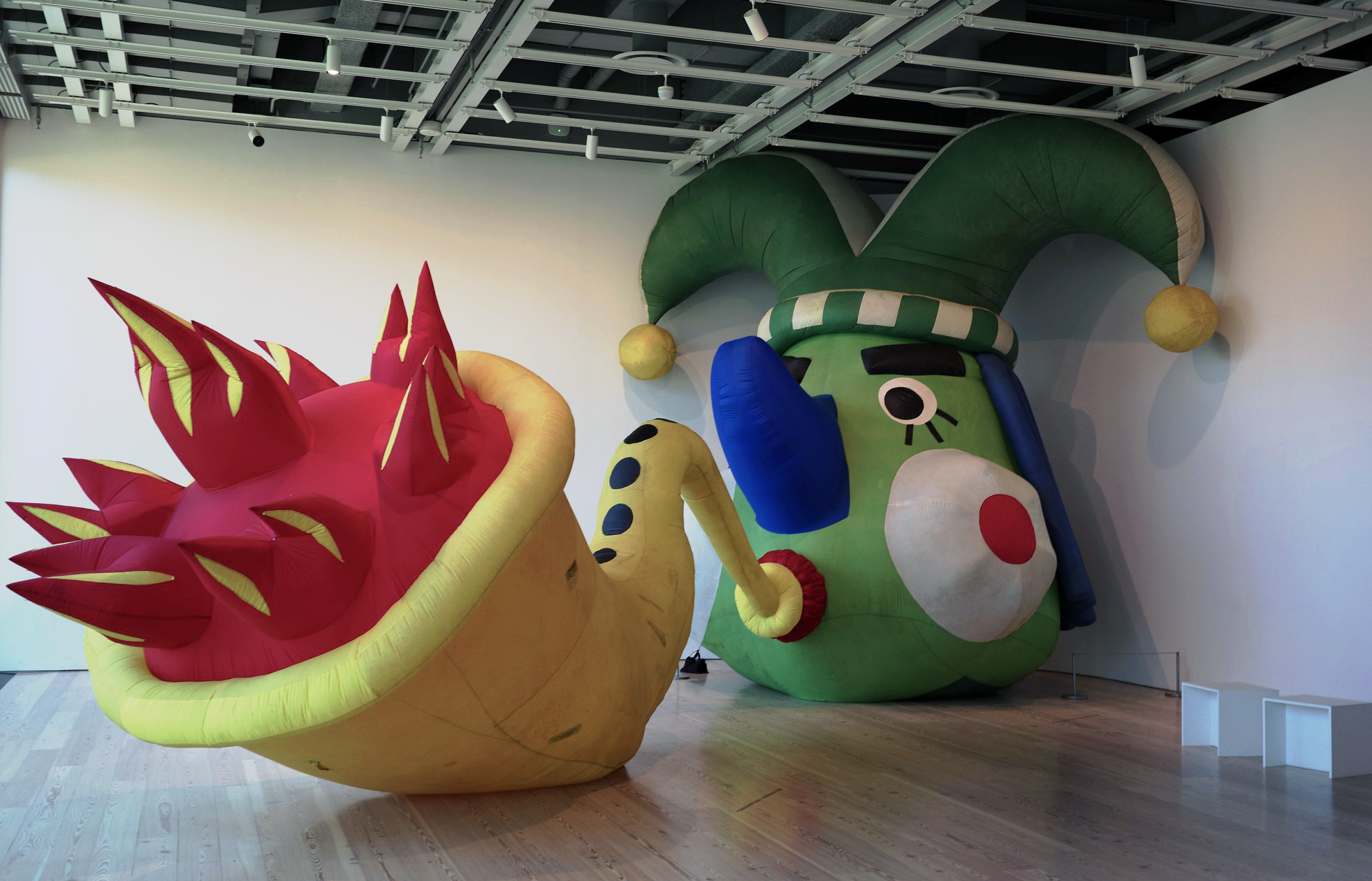
Pat Oleszko's Blowhard (1995), a stitched figure that inflates into a horn-blowing clown, reads thirty years on as an oddly fun-house contemporary note — the gestures of digital politics rendered in nylon. I welcome its eccentricity. It may be the show's truest self-portrait: a carnival jester performing an inflated promise.
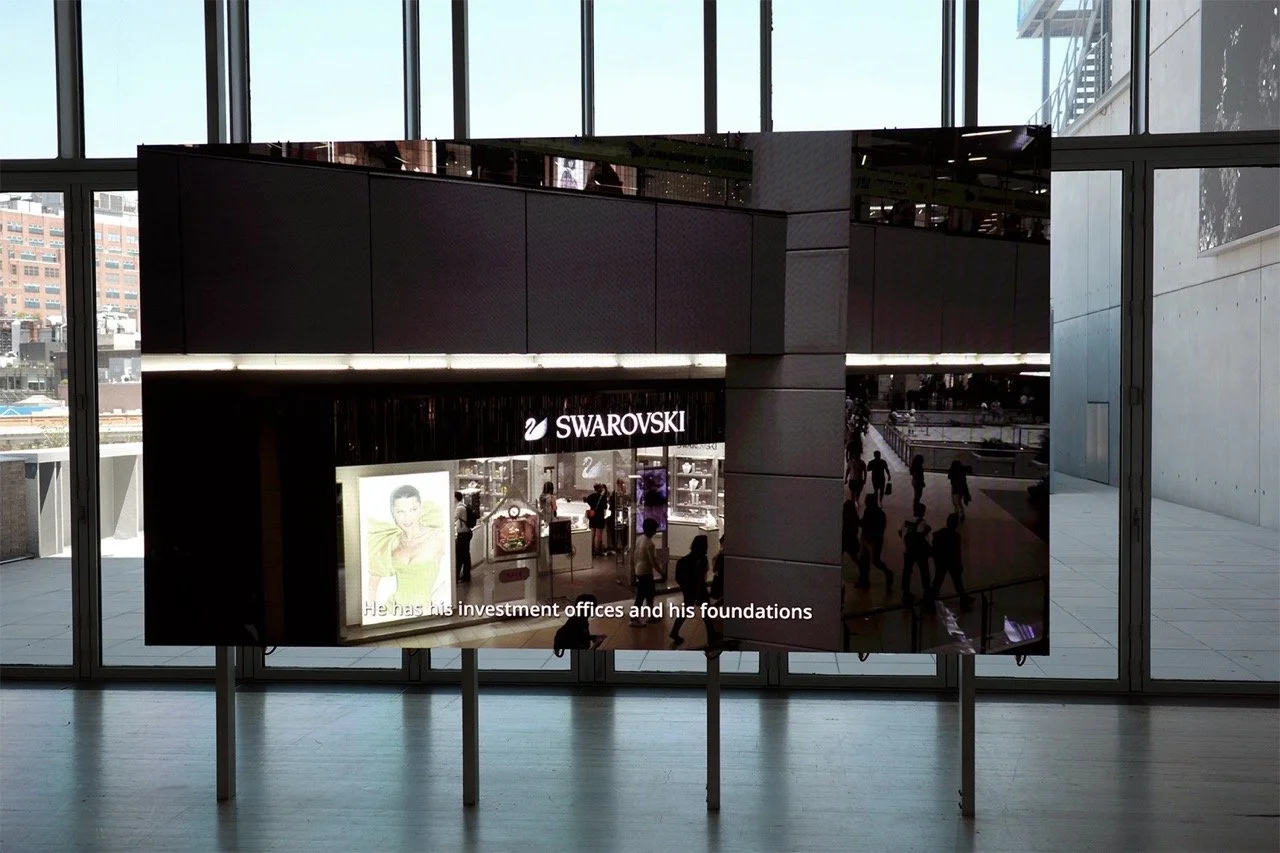
The work that should have anchored the exhibition is Basel Abbas and Ruanne Abou-Rahme's Until we became fire and fire us (2023–ongoing), a three-channel video and sound piece by the Palestinian duo. A narrator searches for ten of some five hundred erased villages, identifiable by the cactus that survives where the houses did not; the work moves between grief and dance and returns, across its runtime, to a single line: THOSE WHO CHANT / DO NOT DIE. It is one of the rare moments in the Biennial that pressurizes the room it sits in, and still it has been tucked away in a distant side room, with visitors hesitating to enter. Ignacio Gatica’s Sanhattan, a cool dissection of finance capital and the neoliberal skyline is assigned the same fate. Downstairs, by contrast, Zach Blas’ CULTUS with its red light and occult voiceover is given the daylight. The pattern is not subtle. Spectacle gets the daylight; argument gets the closet. But don’t mistake this spectacle for anything more than soft-serve radicality — sweet enough to signal dissent, too smooth to make anyone choke.
The most pressing American fault lines are not absent from the building; they appear on the fringes, delayed or muted. The discomfort a Biennial of this stature exists to stage is not erased so much as managed.
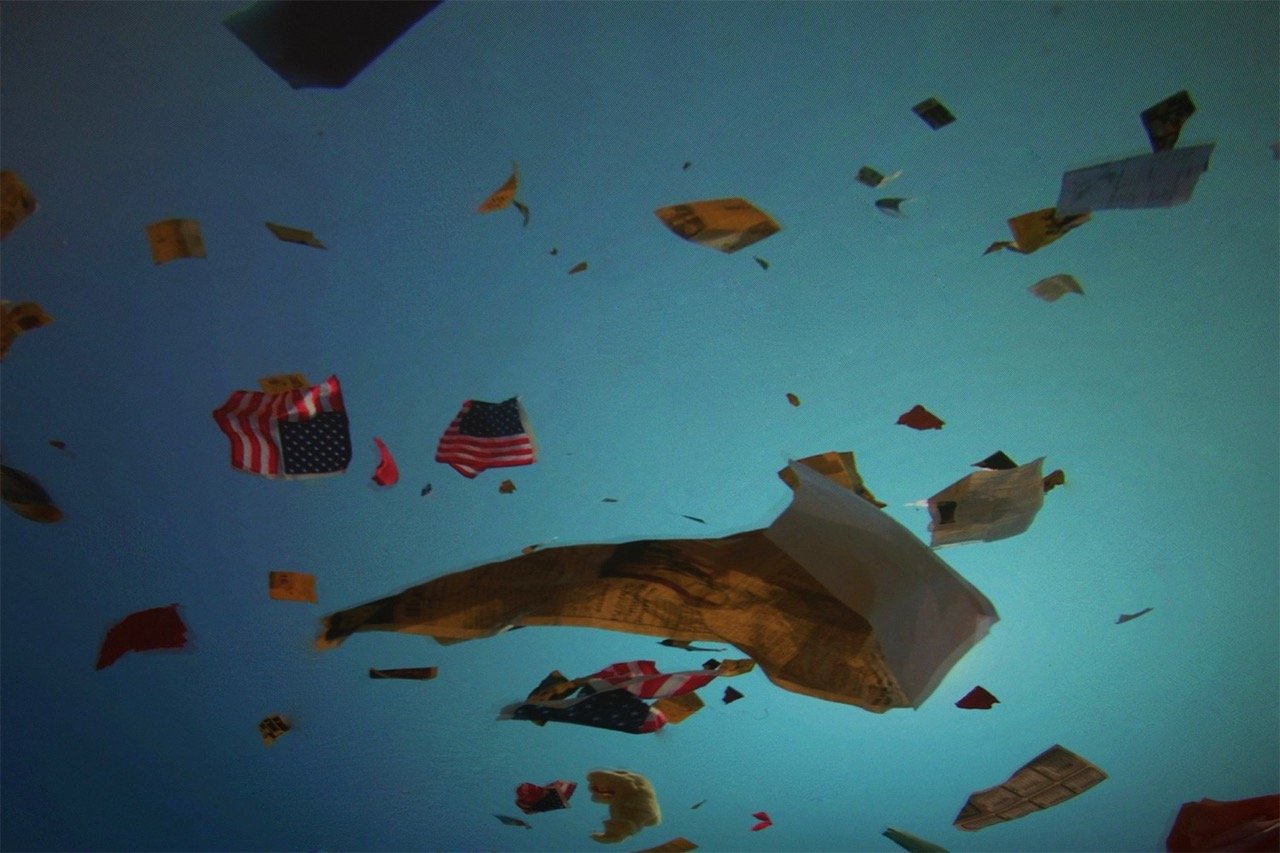
Elsewhere, the gestures are familiar: Zach Blas’s AI mysticism, Cooper Jacoby’s sentient intercoms, Michelle Lopez’s planetarium-scale whirlwind of tattered flags and trash — the same apocalypse I walk through in Bushwick every morning, except in 4D and thirty dollars cheaper. A single small Kara Walker, almost like a citation. A suite of provocation videos that know exactly who they are shocking, which is to say: nobody in the room, least of all the institution itself. Warhol made genuinely unsafe films sixty years ago; this is the performance of that risk, not its substance.
I don’t accept that scoring art is philistine; judgment is the work of criticism. The rubric is straightforward — invention, execution, cohesion, presentation, risk, and above all authenticity, the correspondence between what a show claims to be and what it does. Did I learn anything I didn’t know? No. Did individual works move me? Yes, and almost always in spite of their context. Did I leave inspired? Sure — inspired to talk shit. Jokes aside, did the exhibition engage honestly with the country it purports to survey? It did not. That last failure is the one this score will be measuring.
There is a longer history here worth naming to remind ourselves of the institutional hands at play. The American-art apparatus the Whitney helped define and operate during the Cold War — the museum and the state colluding to influence and define “Great American Art” through propagandistic measures — is a weight that remains. One need not allege anything about present sponsors to observe that an institution positioned as an emblem of American reach has, in this edition, declined to authentically turn that scrutiny inward. Whether the cause is timidity or patronage, the curatorial through-line says the same thing.
To be clear, this is not the reflexive “America is bad” posture, which is itself the safest position in the room and the one that staffed half of today’s curatorial class. Taking a country seriously means attending to where it is in pain — its institutions, its ecology, its mind — rather than aestheticizing that pain into something frictionless. We have watched a decade of genuine movements get absorbed, sanitized, and redecorated as institutional taste. The questions that remain — the failure of the political settlement, the redistribution of power offshore, the slow surrender of the real to technology — are present in fragments: as images, devices, moods, and side arguments. What is missing is any sense that a cultural superpower has no shortage of media or AI, but a growing deficit of conviction. What is missing is not reference, but force.
The show takes roughly the same amount of risk as an algorithmically generated “alternative” playlist: a generic controversial take delivered as a lifestyle preference. Its closest approach to blood — the Okoyomon, and almost everything else is another form of taxidermic expressionism: rebellion killed, mounted, and arranged into a Harawayan diorama from Teddy Bear Patriarchy. Works with teeth sit in side rooms, flattened and out of the way, like the parts of American life the exhibition would rather not address. It looks outward to avoid looking in. Outside of Walker, Okoyomon, Martínez Poppe, and a few others, it barely sustains contact with Blackness, with class, with the material conditions that a generation of younger artists in mid-tier galleries are already circling with more nerve.
So: 2.7. It clears the floor only because it is an institution, and because a handful of serious artists keep it from sinking further. That is not a margin to be proud of; it is a reprieve the show did not earn.
Bring the blood. Bring the argument. Make us think harder. It doesn’t need to be difficult. Just honest. Those who chant do not die. The ones who look away — fine. I’ll point them out.
Header
Written by Nil Defaul-Tumore
Image courtesy of Nil Defaul-Tumore
CREDITS